
Creating a Low-Maintenance Landscape
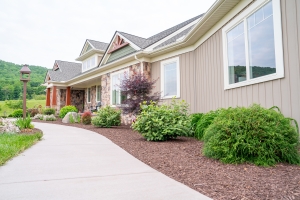 Nearly every free consultation I do, homeowners and business managers will quickly toss around two words: low maintenance. Now, as I have heard my father say several times, even if you put something plastic or vinyl in your yard, you still have to power wash it! Creating a low-maintenance landscape is attainable. No maintenance—not so much.
What Makes a Landscape Truly Low-Maintenance?
There are a variety of factors that influence the amount of maintenance and its difficulty level a landscape requires…
- How old is the landscape? A mature landscape, 25 years old, will require more maintenance than a young landscape in a new home.
- How many shade trees are around your home? You may or may not have large shade trees, but if your neighbor does, you likely collect at least some of them. Remember, trees are good for nearly all living things. Leaf litter requires clean-up if you want good, healthy grass (more on that below).
- Soil nutrition and quality. Bad soil can have some of the worst, deep rooted, herbicide resistant, hard to pull weeds grow in it. Overly rich soil can be an easy seed bed that supervises you with something new every day. Weeds are going to grow, particularly with rain—regardless. Whether you have mulch, fabric under mulch, landscape gravel, pinestraw, pine chips, or groundcover plants covering your plant beds, weeds are going to find their way to show themselves.
- Plant species. The type of plants you have in your landscape influences how often and how much maintenance is required. Example: ‘Wintergem’ Boxwood grows 6-12” a year as opposed to ‘Little Missy’ that is 2-4” per year. A ‘Limelight’ Hydrangea grows faster and bigger than a ‘Little Lime’ Hydrangea (as its name implies). That means longer limbs, more frequent pruning, more to clean up.
- Budget, time, physical ability, method of choice. Retirees may have aches and pains, but they do generally have the time as opposed to a father of three or a middle-aged adult who travels most of the week for work. Do you mind spot-spraying herbicide or prefer to hand-pick/pull weeds? Are you a DIYer, or prefer and have the ability to hire someone for some or all tasks? Do you have a small tractor or piece of equipment that is helpful?
- Accessibility and grade of the property. How hard is it to walk around the perimeter of your home and property? Do you have to carry everything by hand or can you drive a pickup/trailer/equipment around your home easily? Slopes, whether young or elderly, will make your legs remember how hard simple tasks are.
- How good do you want your landscape to look? Crisp bed edges, weed-free lawn, not a leaf goes uncollected, nor a dead limb found anywhere or are you more of the type… Leaves everywhere, dandelions are pretty, don’t mind making hay off the yard every so often, gather up dead limbs only for a campfire this Fall, love my plant beds full and natural looking, imperfection is perfection. Most of us are somewhere in between.
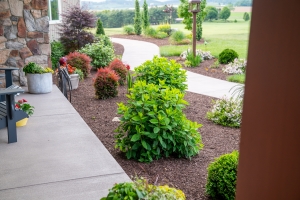 With all that in mind, below are some simple recommendations to make a landscape feel low maintenance:
1. Have a plan and outlook!
Think about the year ahead and plan what you need to do and when, so you can stay on track. Don’t try to accomplish too much at once! If any certain aspect seems too challenging, consider hiring out a local service to ease the burden.
2. Make your property easy to mow with bed design and curvature.
There’s a delicate balance between the amount of garden beds and grass in your landscape that I revisit in point #7 below. Even if you enjoy walking behind a push mower, a landscape that flows well makes mowing feel much easier. Great designs and planning minimize the need for a weed eater. Create plant beds or gardens on slopes and hard-to-mow terrain. Mowers often act as vacuums in our home in that they keep a property looking clean and neat and make litter and debris disappear.
3. Prune plants in increments to keep from overburdening yourself all in one weekend.
There’s quite a range in time of year that certain plants can tolerate or prefer pruning (see below). A Saturday every few months can go a long way toward feeling manageable rather than pruning every single plant in the same day.
- December – January: Grasses (Miscanthus), Hydrangeas, Roses, Butterfly Bushes, perennials (Catmint, Black Eyed Susans, Daylillies, etc). Pruning these types of plants greatly eases the difficulty of leaf removal and removal of the “dead” look of Winter landscape early on.
- February – April: Evergreens that require shearing – Boxwoods, Yews, Laurel, Holly, Cypress
- May – June: Spring bloomers – Lilac, Viburnum, Rhododendron, and any other flowering shrubs that bloom on “old wood”. Trees that sucker – Fringe, Magnolia, Dogwood, Crapemyrtle (clean off undesired growth from trunks, elevate limbs)
4. Like it or not, weeds will come!
For ease in management, we recommend a handheld sprayer and Round-up ready to go as needed. A 10-minute walk around your home once a month can easily take care of weeds.
5. Leaves have a shelf life
Unless you want them as a mulch or cover in a natural landscape, don’t let leaves stick around to get wet, heavy, and moldy. Leaves naturally prevent evergreen shrubs and grass from being able to breathe. Pick up your leaves once they’ve all fallen, preferably before any snowfall. Wet leaves are a much harder task than dry leaves.
6. Mulch to your ability
Generally, a refresh of mulch is ideal once every two years. A lot of methods to accomplish mulching your beds (bagged, bulk, delivery), but think about what’s best for you. Keep in mind that mulching is much less of a task if plants are pruned and beds are clear of leaf litter ahead of time (back to point #1).
7. Design and install the landscape that fits you!
Design to your preference and ability, update if needed. Be selective in plant material based on your taste and the effort you want to put toward your landscape. An old landscape can be much less maintenance—and much closer to a low-maintenance landscape—with an update or overhaul.
Contact us today for expert advice or visit our nursery to find the perfect plants and materials for a low-maintenance landscape!